Notes from the Sea Floor
A spatial listening environment for the soundscapes of the oceans.
Entering an underwater world through sound.
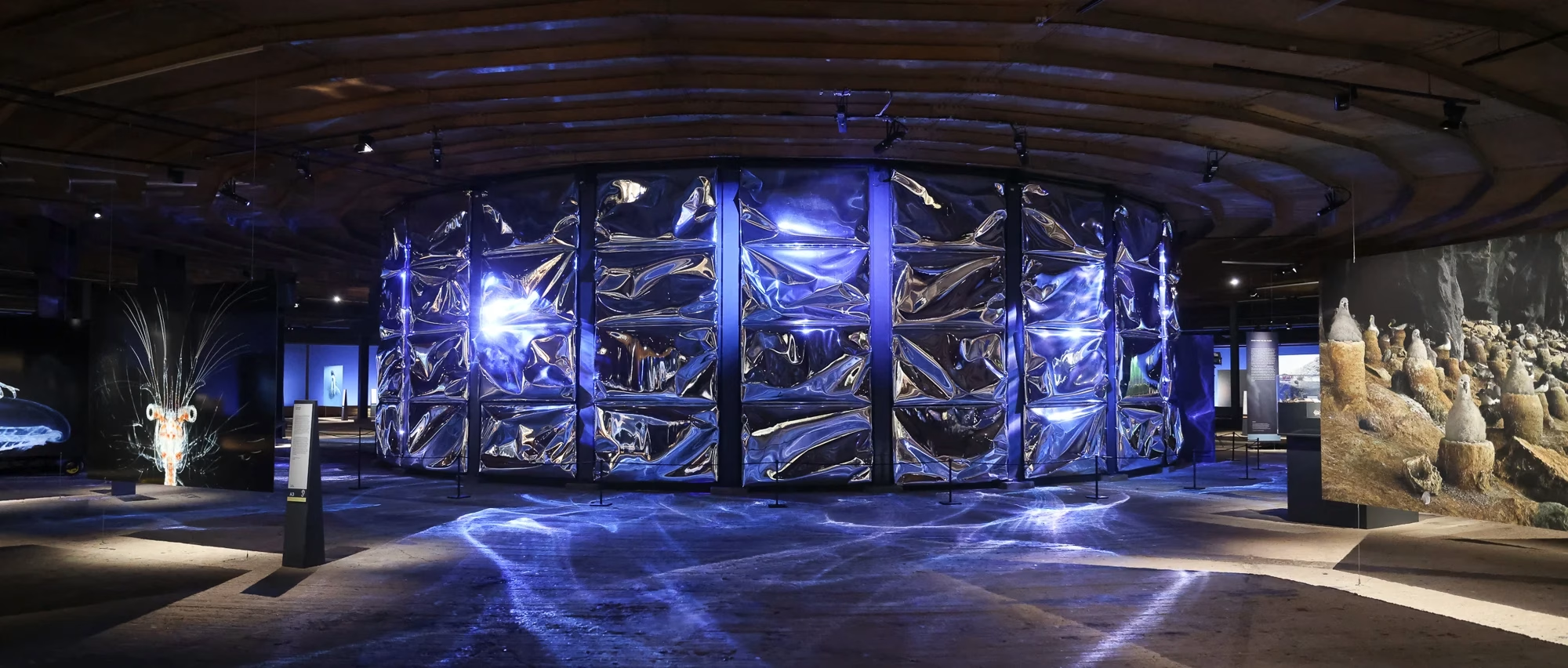
At the centre of the Gasometer Oberhausen, a cylindrical spatial sculpture creates a listening environment for ocean soundscapes. The composition travels from the mouth of the Rhine through the Atlantic and Pacific to the Antarctic.
Seals, whales, dolphins and crustaceans appear alongside currents and moving ice. The work reveals marine environments through the sounds their inhabitants produce and depend on, drawing attention to the effects of human noise on those habitats.
Making a listening space buildable.
I led the technical design and planning, and oversaw production coordination and installation. My work connected the spatial concept to the construction of an interior within the existing Gasometer exhibition space.
Chris Watson developed the field recordings and composition, Tony Myatt the spatial sound design and programming, and Theresa Baumgartner the visual concept. Verena Bachl contributed artistic production and development. The installation was produced by OCEANS21 for the Gasometer Oberhausen.
A major construction challenge was acoustically isolating the installation from the surrounding exhibition hall. The planning and acoustic documents show the level of detail needed to communicate a solution across the design and construction team.
Plan
Translate the spatial concept into technical information.
Coordinate
Connect design development with production and construction.
Install
Realise and integrate the work on site.
03 / Space & construction
A room within the existing structure.
The construction drawings describe the circular arrangement, its wall sections and the relationship between the interior and the supporting structure. Plans, sections and three-dimensional views make different parts of that relationship legible. After the exhibition, the created space needs to be dismantled without leaving any traces in the protected historic monument of the Gasometer.
The finished experience conceals much of this work. The process material below shows how the cylindrical room was assembled within the larger building and how its individual elements fit together.
04 / Acoustic environment
Building the conditions for listening.
The room had to be isolated acoustically from the surrounding exhibition hall. That requirement made construction detail and communication central to the project, alongside the multichannel sound system and acoustic treatment itself.
The photographs show suspended acoustic elements and the treatment around the upper edges of the interior.
Designed for daily use by museum staff.
System integration had to make installation straightforward, so museum staff could run it without the project team’s supervision. The work was therefore not complete when the light and sound systems could operate individually: they also had to function as a usable whole.
We developed custom software and specific operating instructions to support that daily use. This connected the technical integration to the people responsible for opening, running and looking after the installation.
From construction site to ocean journey.
Presented as part of Planet Ozean in 2024–25, Notes from the Sea Floor brings a remote and often unseen environment into a place of public encounter. The German exhibition title is Klang der Tiefe.
The photographs move from the existing framework to the completed light environment, showing how the same volume becomes a space organised around listening.