Possibly Colliding
Two revolving arms, an anticipated collision and a changing sound field.
Waiting for a collision that keeps moving away.
Two counter-rotating arms create the expectation of a collision. Their movements repeatedly approach and pass through a changing relationship, producing a tension between what the visitor anticipates and what the mechanism actually does.
Light and sound emitted from the ends of the arms make that movement perceptible. The work stages time and distance as a physical event: the apparent meeting point changes as the two rotations slip in relation to each other.
Developing the moving structure.
Within FELD, I worked on mechanical and hardware design, prototyping, production and installation coordination. My contribution connected the central movement idea to the mechanism, its supporting structure and its realisation in the Barbican foyer.
FELD led the creative and art direction, and Ben Lukas Boysen developed the sound. The technical work had to support an experience in which movement, light and sound remain closely related.
Mechanics
Hardware and mechanical design.
Prototype
Physical studies of movement and scale.
Realisation
Production management and installation coordination.
The moving source changes what we hear.
The installation’s sound comes from the moving ends of the arms. Their rotation changes the listener’s relationship to those sources, producing variations in loudness, phase relationships and Doppler effects.
The mechanism therefore does more than carry an image of motion. Its actual movement contributes to the sound field around the work, connecting a visible trajectory with an auditory change.
Testing the idea at physical scale.
The early prototype photograph shows the movement arrangement outside the studio. It is a direct way of examining the relationship between the arms, the support and the space around them.
The architectural study then places the installation in its exhibition context. Together, the prototype and drawing connect the mechanical question to the conditions of a public foyer.
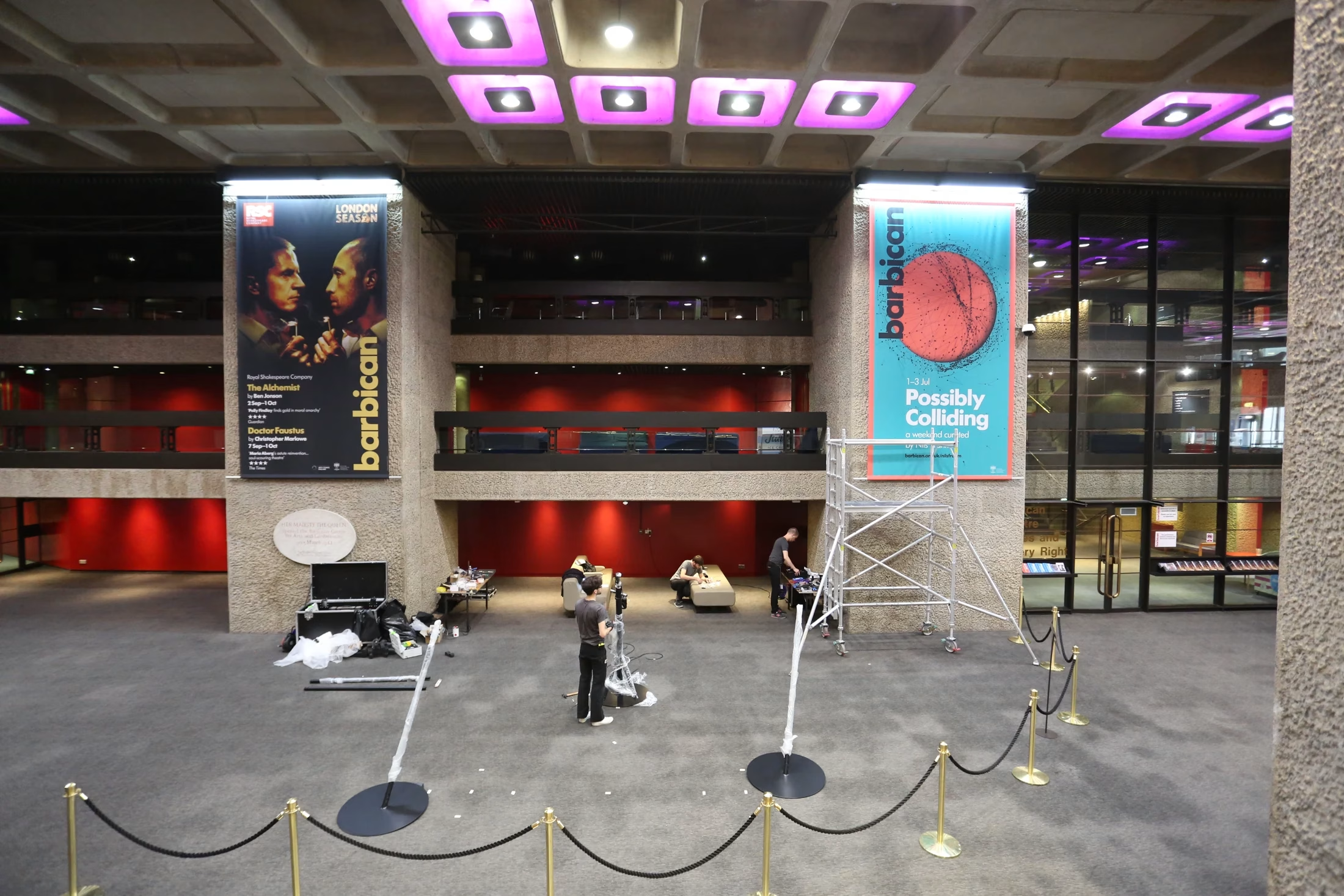
Assembling the work in the public foyer.
The on-site photographs document the modular supporting structure and the installation work around it before the presentation was complete. They expose the making behind the apparent simplicity of two moving arms.
Commissioned by the Barbican Art Gallery, Possibly Colliding was presented in London from June to September 2016.