01 / Experience
A changing space,
without moving its walls.
As visitors move around a water basin, small mechanisms dip into its surface, creating waves. The ripples they create become the input for an evolving spatial sound composition.
Movement passes through water into sound, changing how the surrounding space is experienced.
Funded in part by:

- Year
- 2021
- Location
- MIT Media Lab and Wiesner Student Art Gallery, Cambridge, USA
- My contribution
- Concept, design, hardware, software and sound
- Homepage contribution summary
- Concept, interaction & sound
- Artistic authorship
- Karsten Schuhl
- Context
- independent artistic research

The water basin and spatial sound system in the MIT Media Lab lobby.
02 / The installation
One connected system.
Developed end to end.
I developed every part of superpose: the mechanisms, custom motor-control PCBs, Arduino firmware, visual tracking software and sound composition as a research project at the Opera of the Future group.
Physical development
Mechanisms, enclosure, fabrication and custom electronics.
Interaction & software
Audience sensing, motor firmware, visual tracking and MIDI control.
Spatial sound
Composition and spatialisation in Ableton Live.
03 / Interaction
The water is part
of the instrument.
Twenty-four ultrasonic distance sensors each correspond to a motor. The timing and speed of changes in a visitor’s movement influence the size of the ripples generated by the dipping mechanisms.
Custom software visually tracks the ripple activity and intensity, translating it into MIDI controls. These shape the direction, auditory density and structure of a spatialised composition in Ableton Live.
01
Movement
24 ultrasonic sensors track changing distance.
02
Ripples
Motor-driven mechanisms dip into the water.
03
Tracking
Processing translates ripple activity into MIDI.
04
Sound
Ableton Live shapes the spatial composition.

Ultrasonic sensors along the basin.
04 / Film
See—and hear—the interaction.

Playing connects to Vimeo and shares your IP address and device information. Vimeo may use cookies and process data outside the EU.
Project film — filming and editing: Jimmy Day. Sound: Karsten Schuhl. Watch on Vimeo ↗
05 / Development
From a small gesture
to a working installation.
The development connected studies of water movement with mechanical prototyping, electronics and full-scale fabrication.

01 / Overview of the final sensing and kinetic assembly

02 / 3D-printed dipper tip forms.

03 / Motor assemblies and control electronics.
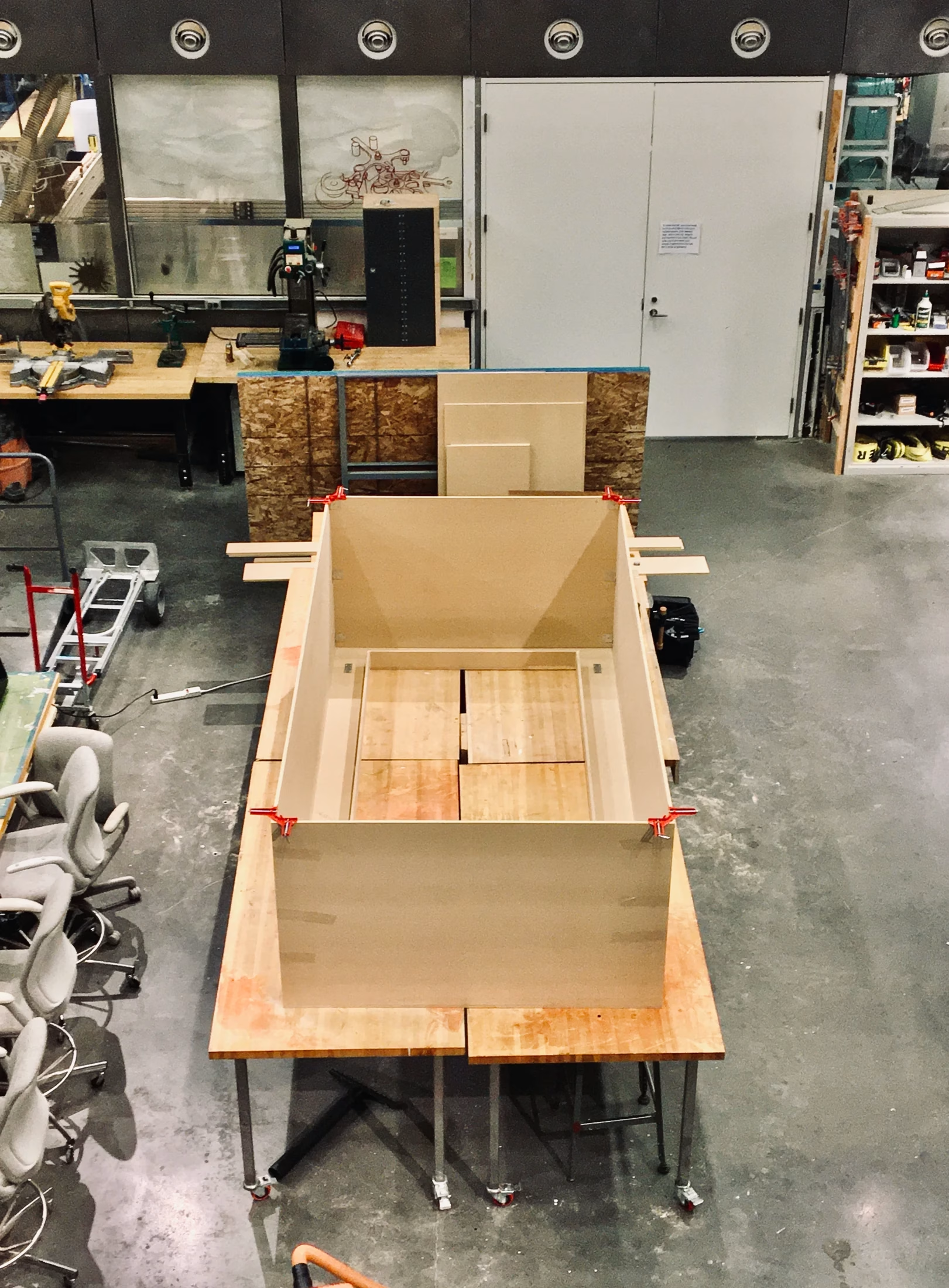
04 / Fabricating the enclosure.
The build, in motion.
Playing connects to Vimeo and shares your IP address and device information. Vimeo may use cookies and process data outside the EU.
Build timelapse: Karsten Schuhl. No sound. Watch on Vimeo ↗
06 / Research
Working with perception.
superpose explores how the experience of space can change through sound, material and movement. The research interview introduces the thinking behind the installation.
Playing connects to Vimeo and shares your IP address and device information. Vimeo may use cookies and process data outside the EU.
Read the research interview transcript
English transcript from the captions supplied with the original MIT Media Lab video. Caption wording is retained and may contain transcription errors. Interview: Jimmy Day and Dan Novy.
00:00
[mellow music] - Hi, I'm Karsten. I'm with the Opera Of The Future Group. Staring at water is, I think for a lot of people, something calming. Mostly if I say staring at water, it would be moving water, waves, a stream,
00:24
and there also sound comes in. So it's the, the noise, the, (waves crashing) of all of this, that is, that is happening. That calms me down, but also focuses me on the rhythm of what is happening.
00:41
And so it's very much just being in the moment, being there, experiencing just what is happening outside of you, but what's also connected to you. And this is what I hope to link back to my project itself to say, okay, I'll create a wave in a very abstract pond of water, but it is related to me,
01:01
but it also relates to the sound. And therefore the connectedness of the space around me, and what I impact in there, hopefully meshes as well. Listening to spaces is a passion of mine. Then I find those moments that, just by walking through a space,
01:19
through something that somebody has dreamt up and built, changes our perception of how we relate to this space and how this space actually comes back to us. Tiny vibrations from our voices or anything that we, that we hear is basically the tiniest, tactile information we can get from the world.
01:43
The project behind me, I call it a Superpose. It's an interactive spatial installation that is meant to give an audience the opportunity to interact with a metaphor of sound and space through the medium of water. So someone walks up to this block of water
02:07
and they will trigger a wave in the water. This wave will then be scanned and specialized in sound. And therefore, whatever they do to the water will have resonance in space, and therefore repercussions and impact on their perception of the space through sound. So it's about creating a fluid
02:32
and changing perception of space through sound with the help of water as an intermediary. Imagine a large warehouse, kind of darkened. You don't necessarily have sunlight in there, but you walk on britches and there's black water underneath you.
02:51
So that's the scale of what I wanted to go. So every bridge or everything you walk, you kind of walk over the water and everywhere you go, you create one of those ripples, and those ripples go back into this space and they come back to you as a sound.
03:03
Spaces around us are non-reactive, highly static. We are the dynamic part of this, and if we could give spaces those, a little bit of agency that they actually see, feel, know, are aware of what is happening in them, and they could change their structure and their acoustic
03:25
properties towards what is happening in them, that would be amazing. And I hope that my work, that's actually my trajectory for the future as well. To make spaces more knowledgeable and changeable, dynamic in acoustic parameters,
03:40
and also for humans in them. The media lab itself values more the, okay, how do you think about something, rather than, okay, of course you are the best qualified person for this to do. You're already skills beyond compare. Helps in getting something out the door,
04:01
or getting something done, but if you don't have the right concept for this, and this is all what we value quite a lot here, you can always learn the skill for this. There's always someone in the media itself who knows about highly detailed electronic design.
04:18
Or if you go down to Biomech, for example, they're all mechanical engineers, so you can ask them about, okay, what's the tensile strengths of this bolt if I need it for this kind of motor because I will basically just wreck everything if I don't do this.
04:33
So my hope is that the overall, that the project itself will give people the perception of the connectedness of, okay, there is a space, but if I'm in that space, I also change the acoustics, change the sound in it. And if this awareness is somehow granted through this, awesome, and people go out the door,
04:54
maybe forget about this, but are a little more aware of what is happening around them in terms of acoustics or sound. That would be optimal.
Wave influence · 2020
An early study for superpose, developed in the MIT Media Lab Arts@ML class. Motorised faders disturbed the water surface while custom camera analysis translated wave motion into MIDI data.
Wave propagation simulation · 2020
An earlier web-audio study explored the sonification of interacting waves through additive and frequency-modulation synthesis. It was developed in the Sound: Past & Future class at MIT Media Lab.
07 / Details
Exhibitions
MIT Media Lab, public lobby
Cambridge, USA
8–19 August 2021
MIT Wiesner Student Art Gallery
7 September–6 October 2021
Credits & support
Installation, hardware, software and sound
Karsten Schuhl
Photography
Jimmy Day, as credited
Funded in part by the Council for the Arts at MIT.