
01 / Question
Hearing beyond the room we see.
Sonic Envelopes is an ongoing artistic enquiry into sound, material and spatial perception. It asks how a sonic atmosphere might draw us into a space that extends beyond – or differs from – the room we see, and how moving through it might change what we hear.
The enquiry brings together experiments that may develop into installations, instruments or individual works. Composed sound and the sounds already present in an environment remain equally open starting points.
- Year
- 2021–ongoing
- Location
- Dessau and Berlin
- My contribution
- Concept, design, hardware, software, prototyping
- Homepage contribution summary
- Artistic research & prototyping
- Artistic authorship
- Karsten Schuhl
- Context
- Independent artistic enquiry
02 / Listening & space
An atmosphere to enter.
I want to create atmospheres that draw listeners into a sonic impression of space beyond its visible boundaries. Movement offers another way into that experience: changing position might reveal a different relationship between what we hear and where we are.
My work brings composition, material exploration and technical development into this enquiry. Early research at Anhalt University’s Materiability Group focused on adaptable room acoustics. That remains one possible application within a broader interest in how sound and physical structures shape perception.

Conceptual sketches of the intended spatial behaviour of sound.
03 / Wave study
Making wave behaviour visible.
A shallow square water basin offered a physical way to explore assumptions about reflection and interference. Four wave emitters were arranged around its edges, while static geometry in the centre redirected the ripples. The basin had also been used for superpose tests.
Slow-motion footage made the resulting patterns available for closer observation. Early image analysis explored whether useful information could be extracted from those recordings. This was an exploratory water-wave study; it did not establish the acoustic performance of a room or structure.

Early image analysis of recorded water waves, exploring whether camera footage could yield usable information about the observed patterns.
04 / Material & movement
Testing how structures can change.
A kinetic origami test and soft robotic prototypes explored controllable changes in geometry. Their mechanical and control requirements raised questions about how such systems could scale. These were movement and fabrication studies; their acoustic effects have not been assessed.
Other trials investigated possible routes to smaller-scale actuation and accessible prototype materials. They helped identify practical constraints and questions for future work.

Folded geometry from the origami investigations, which explored controllable movement rather than measured acoustic performance.

A readily available perforated material, considered for reworking into prototypes with different densities and porosities.

Electroactive polymer coating trials for micro-actuation. The tests did not achieve working actuation; material handling and laboratory conditions remained limitations.

Prototype overview presented in Dessau as part of the yearly review.

Recorded positions from the soft robotic actuation study, documenting changes in shape.
05 / Spatial possibilities
Imagining the scale of an experience.
The references below explore the atmosphere and scale that future work might address. Fujiko Nakaya’s fog installation offers a metaphor for an environment that changes how people perceive a space and poses the question of whether such an experience could be achieved through sonic work alone.
The ceiling visualisation belongs to the earlier exploration of adaptable architectural surfaces. It remains a speculative study, while future Sonic Envelopes works may take other forms.

Reference: Fujiko Nakaya’s fog installation at the Neue Nationalgalerie, used as a metaphor for fluid spatial acoustics.
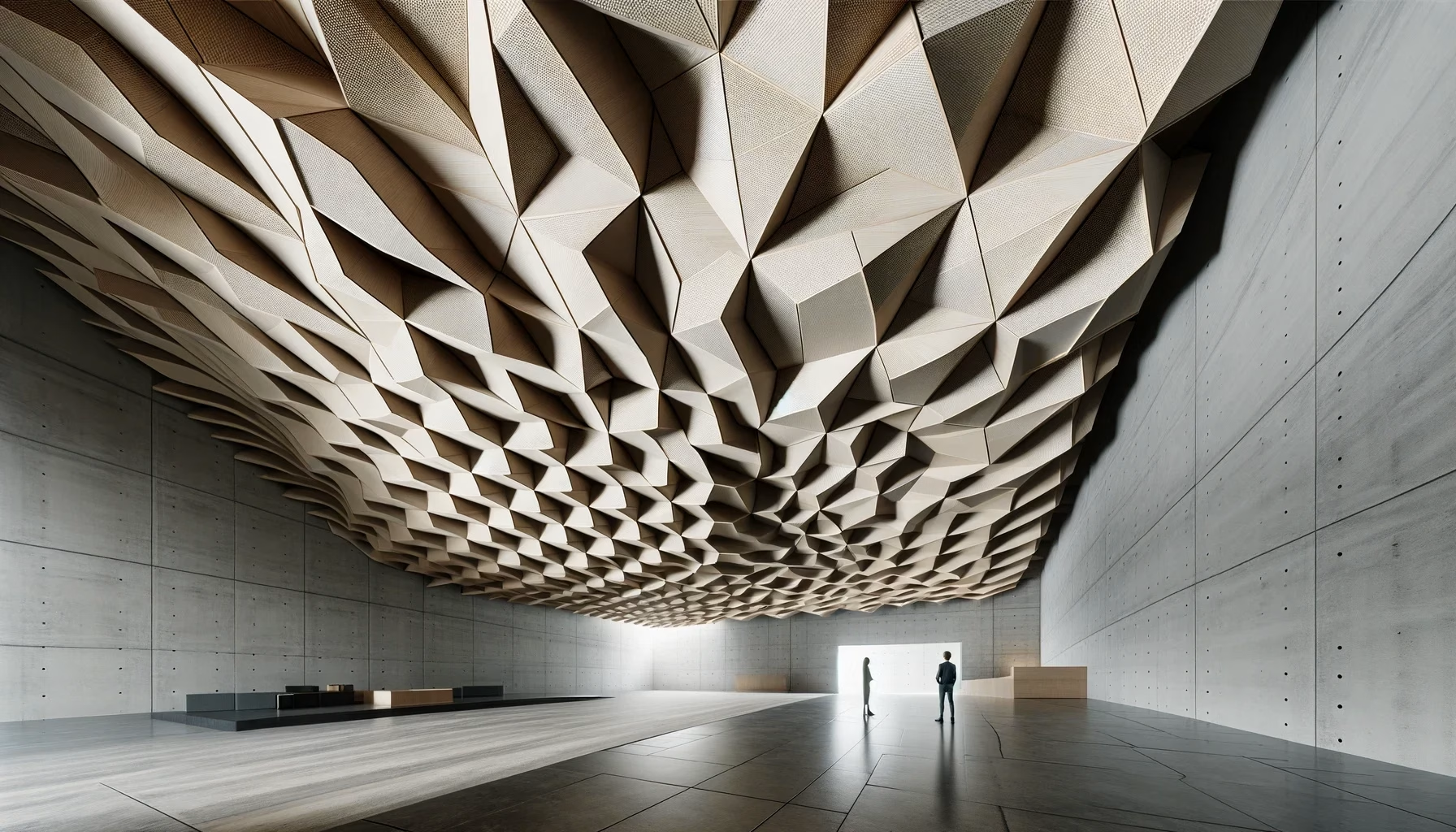
Architectural-scale study. AI-generated previsualisation, not a built project. Previsualisation generated with DALL·E.
06 / Open directions
Returning to the listening experience.
The studies so far have explored physical movement, fabrication and ways of observing waves. Detailed acoustic simulations, acoustic measurements and listening studies remain to be undertaken.
Future work will return to the artistic question: what kinds of listening experiences could emerge from the interaction of sound and material? Metamaterial-based approaches are one possible direction to investigate, including whether they could offer adjustable behaviour with less complex actuation systems. This direction has not yet been tested.
The next experiments could work with composed sound, environmental sound or both, allowing the apparatus and the listening experience to develop together.
07 / Publications
Developing the research in writing.
2025 — Adaptable Architectural Acoustic Surfaces: Actuation and Material Advances for Dynamic Adjustment. Conference paper, Proceedings of ICSV31, Incheon, South Korea.
2024 — Dynamic Acoustic Environments: A Review of Recent Advancements. Conference paper, Proceedings of ICSV30, Amsterdam, Netherlands.
The related Soft Robotic Actuation project presents the pneumatic prototype work in greater detail.
Further reading
Get in touch
Developing the next experiments together.
I welcome artistic and research collaborations exploring sound, materials and spatial perception.
I’m interested in developing installations, instruments and experiments that let people encounter space differently through listening.